The accuracy of biological age tests is measured in three ways. Are the results relevant for long-term health outcomes? Are they reliable with low repeat measurement errors? Are they personalised and relevant to me as an individual based on my age, gender and ethnicity?
GlycanAge meets all three criteria. It associates well with the prediction of future health conditions and future risk of hospitalisation, performing better than the majority of other ageing clocks and traditional clinical biomarkers.
We place quality and accuracy over profit, performing multiple tests on each sample to ensure your results are the most trustworthy measure of biological age available, with an error margin of less than 1%. Any change in your score is a reflection of a true biological change, not an error margin.
GlycanAge was developed from over 30 years of research, results in 200+ supporting peer review publications and a robust baseline of 200,000 samples from some of the world's best biobanks with comprehensive representations of different ages, genders and ethnicities.
GlycanAge is unique amongst ageing clocks.
Unlike other clocks, it integrates genetic, epigenetic and environmental aspects of ageing AND responds to lifestyle interventions. Epigenetic clocks for example don’t respond to caloric restriction or weight loss. GlycanAge does. Our studies demonstrate that lifestyle interventions known to be beneficial for health and ageing, measurably reverse glycan ageing. This makes it an ideal measure for the assessment of longevity interventions.
Telomere shortening for example is the DNA timer that limits the lifespan of a single cell. On an individual cell level, telomeres are an excellent marker of ageing. But, we are all composed of trillions of cells, each of them with a different age and expected lifespan. A large study recently concluded that Telomeres are not a good predictor of age-related health status.
Many epigenetic clocks of ageing have recently come to market - all based on Steve Horvath's discovery that some aspects of DNA methylation correlate strongly with chronological age.
Epigenetics is a form of cellular memory, a field which has significant biomarker potential. There is little research demonstrating what these epigenetic clocks are actually measuring though. The Horvath clock, with which they correlate, is also too linked to chronological age to be useful.
GlycanAge measures composition of the IgG glycome (glycans attached to IgG). The IgG glycome not only changes with age, but also affects inflammation at many levels. Glycans are not only biomarkers, but also functional effectors of ageing. Many studies show accelerated glycan ageing is associated with both unhealthy lifestyle and diseases. In some cases glycans were also shown to be causal for disease development.
And yes, we own the IP, know-how, technology, and patent, and develop the test ourselves.
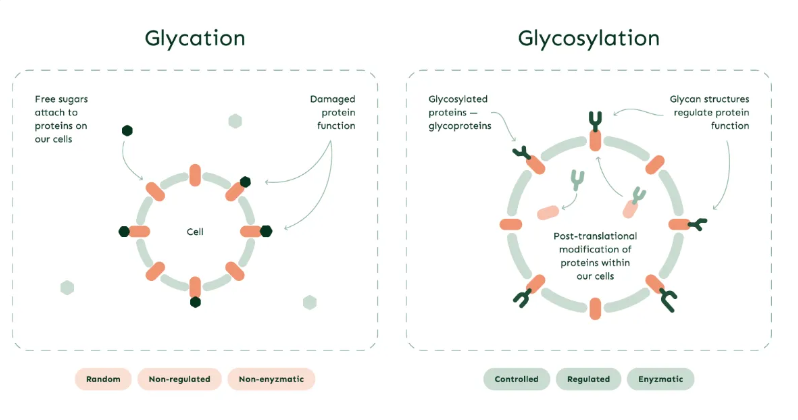
In simple terms, glycation is the damage to your proteins. Glycosylation on the other hand is a very controlled, regulated process of glycans binding to your proteins to regulate their function.